
TPLO Surgery for Dogs in Ames, IA
Advanced knee surgery for dogs with a torn CCL (the injury commonly called a torn ACL).
Get local care, straightforward pricing, clear recovery guidance, and dedicated weekly TPLO surgery availability at Pet Medical Center.
Helping your Dog Get Back on their Feet
If your dog is limping, avoiding a back leg, or has been diagnosed with a torn cranial cruciate ligament (CCL), you probably have two immediate questions:
What does my dog need, and how quickly can we help them feel better?
Pet Medical Center provides TPLO surgery in Ames for dogs with
CCL injuries. Our team will help you understand what's happening inside your dog's knee, whether TPLO is the right treatment, what surgery involves, and what to expect during recovery.
TPLO is one of the commonly used surgical treatments for a torn CCL—the knee injury many pet owners know as a torn ACL.
DOES MY DOG HAVE A CCL TEAR?
Signs of a CCL Injury in Dogs
A CCL injury can happen suddenly, but many dogs develop symptoms gradually.
Common signs include:
- Limping on a rear leg
- Refusing or hesitating to put weight on one leg
- Difficulty standing up
- Trouble climbing stairs
- Reluctance to jump into the car or onto furniture
- Sitting with one rear leg held out to the side
- Reduced interest in walks, running, or play
- Limping that improves with rest but keeps returning
- Swelling or thickening around the knee
Not every rear-leg limp is caused by a CCL tear. An examination, and sometimes radiographs, helps us determine what is causing the problem and what treatment makes the most sense.
What Is a Cranial Cruciate Ligament (CCL) Tear?
The cranial cruciate ligament helps stabilize your dog's knee while walking, running, turning, and bearing weight. In people, the comparable ligament is called the ACL, which is why you may hear a canine CCL injury described as a “torn ACL.” In dogs and cats, CCL disease often develops gradually as the ligament weakens over time. Eventually, it may partially or completely tear, allowing abnormal movement within the knee.
That instability can lead to pain, inflammation, limping, and difficulty comfortably bearing weight on the affected leg. Because the same underlying changes may affect both knees, dogs that experience a CCL tear in one knee can also be at increased risk of developing a similar problem in the opposite knee later.
What Is TPLO Surgery?
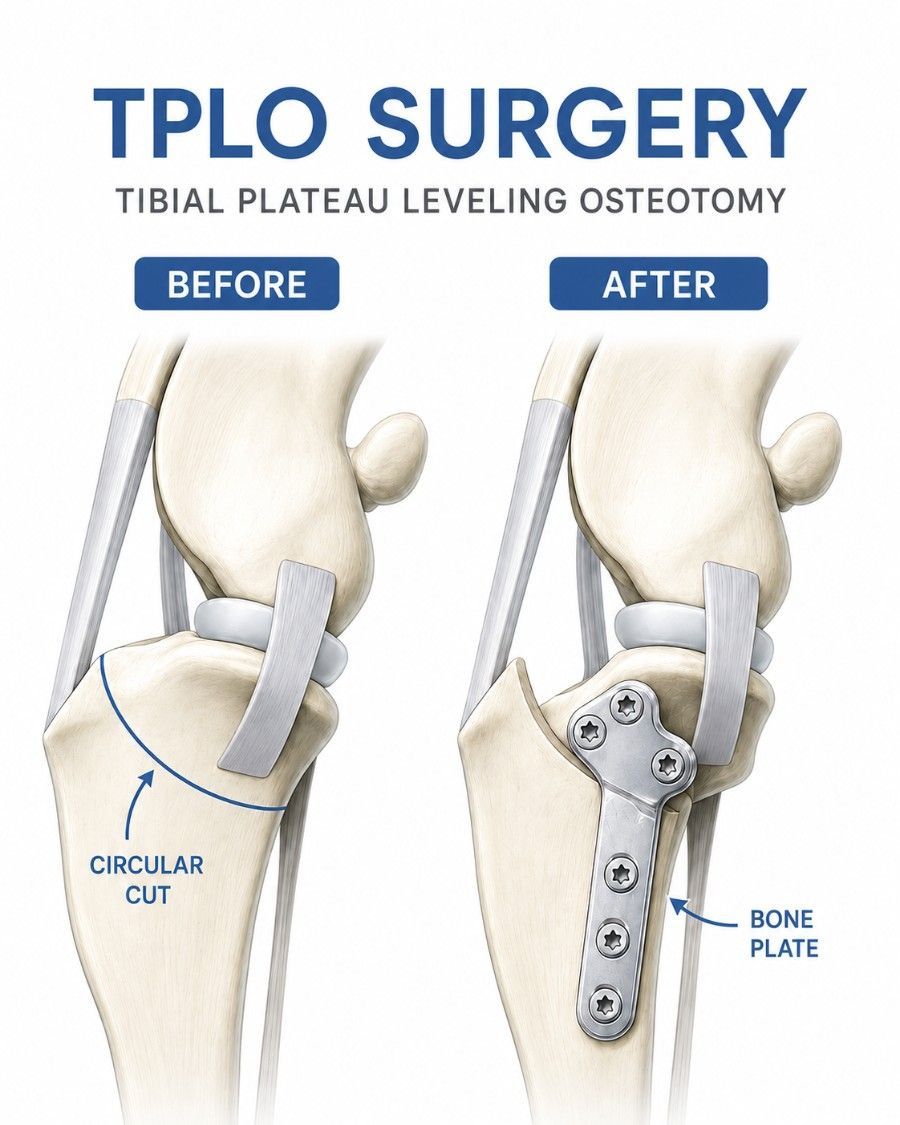
TPLO stands for Tibial Plateau Leveling Osteotomy. Rather than replacing the torn ligament, TPLO changes the mechanics of the knee so your dog no longer depends on the damaged CCL for the same degree of stability while bearing weight.
During surgery, a precise curved cut is made in the upper portion of the tibia. The tibial plateau is rotated to a new angle and secured in its new position with a bone plate and screws. As the bone heals, the knee becomes mechanically more stable. The goal is to help your dog return to comfortable, functional activity.
TPLO is frequently recommended for medium and large dogs and active dogs with CCL injuries, but every patient is different. Your dog's size, age, activity level, anatomy, overall health, and degree of knee instability all help determine whether TPLO is the best option.
How TPLO Stabilizes the Knee
- Evaluation and surgical planning. We evaluate your dog's knee and review the radiographs needed to plan the procedure.
- The tibial plateau is repositioned. During surgery, Dr. Rosel makes a precise cut in the upper tibia and adjusts the angle of the tibial plateau.
- A plate and screws secure the bone. The bone is held securely in its new position while the surgical site heals.
- The mechanics of the knee change. After TPLO, normal weight-bearing no longer causes the same forward movement of the tibia that occurs when the CCL is torn. We'll walk you through your dog's specific surgical plan, anesthesia, aftercare, and recovery expectations before surgery.
Have a limping dog?
Why Choose Pet Medical Center?
TPLO Surgery Without Leaving the Ames Area
A CCL injury can already be stressful. Getting the treatment your dog needs shouldn't be more complicated than necessary.
Dedicated Weekly TPLO Surgery Time
We reserve surgical availability specifically for TPLO cases, helping dogs move from diagnosis toward treatment without unnecessary delays.
Straightforward Pricing
You'll receive a clear surgical estimate before moving forward so you understand what is included and what to expect.
Clear Communication
We keep you informed throughout the process and make our surgery team available when questions come up during recovery.
Local Follow-Up Care
Consultation, surgery, rechecks, radiographs, and recovery guidance are available right here in Ames.
We Keep Your Regular Veterinarian Informed
If another veterinarian referred your dog to us, we'll communicate with their clinic and send the appropriate surgical information back after the procedure.
What Does Recovery After TPLO Look Like?
Every dog recovers differently, but TPLO recovery generally happens in stages. Even when your dog starts feeling better quickly, the bone still needs time to heal. Following activity restrictions during the early weeks is an important part of a successful recovery.
First 2 Weeks
Your dog will spend most of their time resting. Short, controlled leash walks are generally used for bathroom breaks. Many dogs begin placing some weight on the operated leg during the early recovery period, although every patient is different. Running, jumping, rough play, and unrestricted activity need to be avoided.
Weeks 2–6
Controlled activity gradually increases according to your dog's individual recovery plan. Your dog may look and feel significantly better before the bone has completely healed, so continuing to follow activity restrictions remains important.
Around 8–12 Weeks
Follow-up radiographs help us evaluate how the osteotomy is healing. If healing looks appropriate, we'll guide you through gradually increasing your dog's activity.
Returning to Normal Activity
Activity continues to increase based on your dog's healing, comfort, strength, and follow-up examination. We'll provide detailed discharge instructions and a recheck schedule specific to your dog.
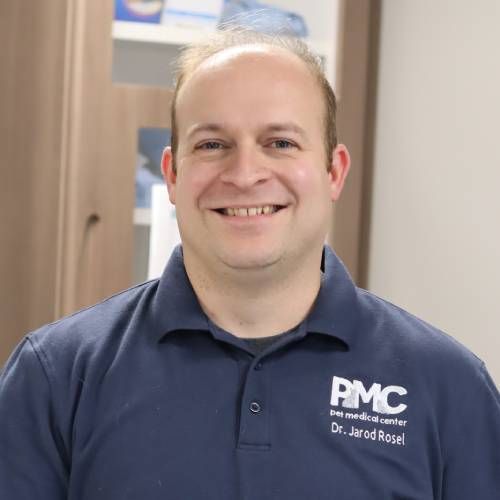
Meet Dr. Jarod Rosel, DVM
Dr. Jarod Rosel graduated from Iowa State University's College of Veterinary Medicine in 2014 and serves as the Owner and Medical Director of Pet Medical Center.
His growing focus on orthopedic surgery came from seeing dogs who needed advanced surgical care but faced barriers to receiving it.
Dr. Rosel now performs TPLO surgery at Pet Medical Center with an emphasis on careful surgical planning, straightforward pricing, and close communication with both pet owners and referring veterinarians.
Getting Started Is Simple
1. Schedule a Consultation
Our team can review an existing CCL diagnosis or evaluate your dog to determine what’s causing the lameness.
2. Review Your Treatment Plan
We’ll examine your dog’s knee, review any needed radiographs, discuss whether TPLO is the right treatment, explain recovery, and provide a clear surgical estimate.
3. Surgery & Recovery
TPLO procedures are performed during our dedicated weekly surgery time. After surgery, we’ll guide you through activity restrictions, rechecks, follow-up radiographs, and your dog’s gradual return to normal activity.
FAQs
Is a dog ACL tear the same as a CCL tear?
Essentially, yes.
In people, the ligament is called the anterior cruciate ligament, or ACL. In dogs, the comparable structure is called the cranial cruciate ligament, or CCL.
That is why you may hear people use the terms “dog ACL tear” and “CCL tear” interchangeably.
Does TPLO repair the torn ligament?
No.
TPLO does not replace or repair the torn CCL. Instead, it changes the mechanics of the knee so the joint is more stable during weight-bearing even without a functioning CCL.
During surgery, the upper portion of the tibia is cut, rotated to a new angle, and secured with a plate and screws while the bone heals.
Is my dog a good candidate for TPLO?
That depends on your dog.
TPLO is commonly used for dogs with partial or complete CCL tears, particularly larger or active dogs, but size alone does not determine whether it is the right choice.
Your veterinarian will consider factors such as your dog’s size, activity level, age, anatomy, overall health, and the degree of instability in the knee before recommending treatment.
Can a torn CCL heal without surgery?
Some dogs can be managed without surgery, but the torn ligament itself generally does not return the knee to normal stability.
Non-surgical treatment may include restricted activity, weight management, pain control, and rehabilitation. Smaller or less active dogs may sometimes do well with conservative treatment, while larger and more active dogs often benefit from surgical stabilization.
The best approach depends on your dog’s individual situation.
What happens if my dog does not have surgery?
An unstable knee can continue to cause pain, limping, and abnormal movement within the joint. Arthritis can also progress over time.
That does not mean every dog automatically needs TPLO. Our team can evaluate your dog and discuss the treatment options that make the most sense for their size, health, activity level, and degree of knee instability.
How long is recovery after TPLO surgery?
Most dogs begin using the operated leg relatively early, but complete recovery takes time because the bone itself must heal.
Activity is typically restricted for several weeks, with controlled leash walking and a gradual return to normal activity. Follow-up examinations and radiographs are used to evaluate healing before activity is increased.
Many dogs continue improving over several months. Your dog’s exact recovery plan will depend on their healing and progress.
Can my dog walk after TPLO surgery?
Many dogs begin placing some weight on the operated leg within the first few days after surgery.
Early activity should still be very controlled. Short leash walks for bathroom breaks are typically appropriate, while running, jumping, rough play, and unrestricted activity are avoided until the knee has healed sufficiently.
We’ll give you detailed instructions for each stage of your dog’s recovery. Vca
How much does TPLO surgery cost?
The cost depends on your dog’s individual case and surgical plan.
After evaluating your dog and reviewing the necessary radiographs, we’ll provide a clear surgical estimate so you understand the expected cost before moving forward.
Schedule a consultation for a TPLO estimate specific to your dog.
Ready to Help Your Dog Move More Comfortably Again?
If your dog has been diagnosed with a CCL tear—or you’re still trying to understand what’s causing the limp—our team is here to help you determine the next step.